When the Herd Goes Silent
“..silence isn't the absence of a signal, it's a signal in itself” - Herd Essence
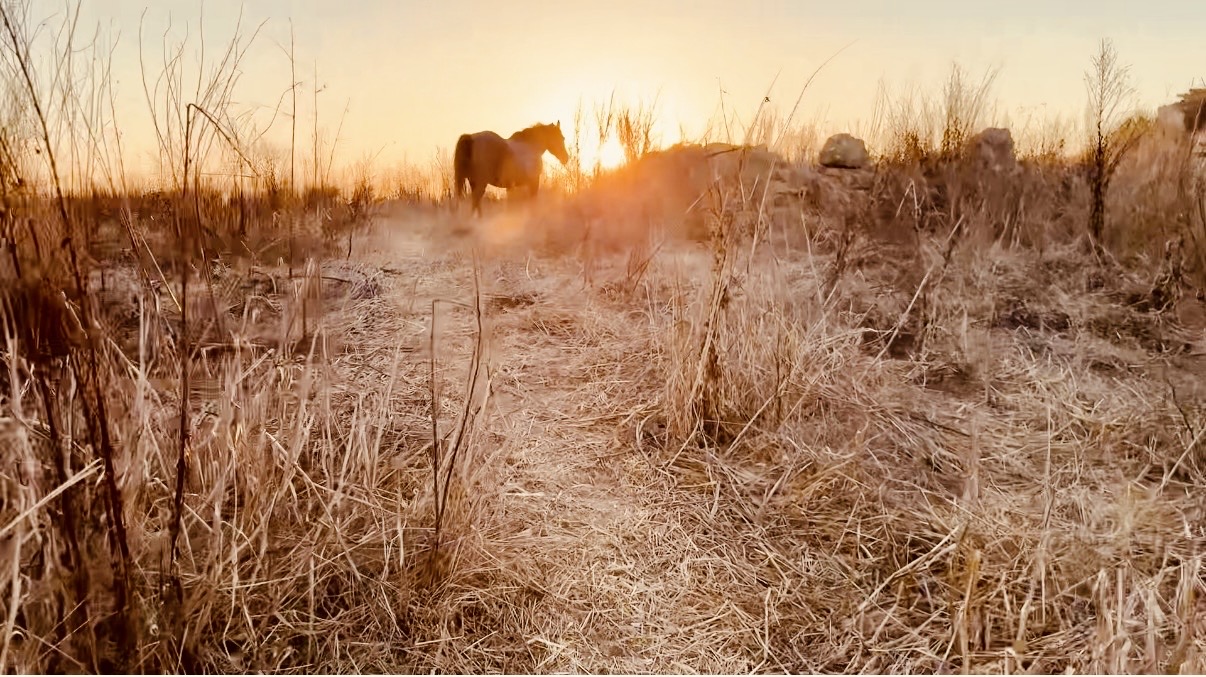
Last week, during the solar eclipse, I walked onto the land to spend some time with the horses. I wanted to see what, if anything, would shift in them during this eclipse which was visible here in Portugal.
After some time I found the four mares grazing quietly in a valley, but soon noticed there were a couple of members of the herd missing. The boys; no Zorro and no Jakob..
The mares weren't calling out. They weren't running back and forth or scanning the tree line with that sharp, upright alertness I've come to recognise as something is wrong. They were simply grazing: heads down, occasionally lifting to listen, then back down again. Aware, but not alarmed.
I sat with them for an hour, half-expecting the boys to wander back into view. They didn't. So I went looking myself, walking the edges of the forest where the land gets thick and the sightlines disappear. Nothing.
I came back to the mares. They hadn't moved far. They were still grazing, still listening, still paying attention, but calm.
Two hours in, Peaches, the lead mare, lifted her head and started walking. Not urgently. Just: it was time. The other mares fell in behind her, and so did I.
We walked almost a kilometre, toward the water source. Now and again stopping to listen before continuing on again. I thought perhaps she knew something I didn't. That maybe the boys would be there somewhere on the way to the water. They weren't. The mares drank, unhurried, and then kept walking a little further before stopping again to listen.
This happened over and over as the sun started to set announcing the end of the day: walk, stop, graze, listen, walk again. No calling. If one of the herd genuinely goes missing, gets separated by a gate left open, the ones left behind escalate. They call, and call back, and the whole herd's nervous system tightens until the missing one is found or reunited. This wasn't that. This was closer to some kind of knowing.
By the time the sun was down, we still hadn't found Zorro or Jakob, and I won't pretend I wasn't worried. But I had one thing on my side: Jakob. Our donkey Jakob has this habit: whenever a herd member is separated or lagging behind, he stays with them. Always. If Zorro was stuck somewhere, Jakob would be right there with him. That, more than anything, is what let me go to sleep that night instead of searching the land in the dark.
I messaged the neighbours, just in case. And planned to go out searching again at first light.

I don't think I'd have trusted that silence if it had been the first time.
The first time was almost a year earlier, with Gemma. She was - is - our oldest mare, and for years, the clear leader of the herd. And then one day, I couldn't find her. She was no where in the area of the herd. The other horses were grazing, calm, unbothered. And my mind went to the worst place: As I know that when a horse dies, the herd will often stay near the body for a time - bidding a farewell - before eventually moving on. I thought that was what I was looking at. That maybe she had died during the night, and the herd had left her in her resting place. Now calm because acceptance had already arrived.
I went looking, heart in my throat, and found her about half a kilometre away, standing alone under some trees. No wounds, nothing unusual. Simply happily grazing by herself. Entirely at peace.
It happened more and more over the following weeks. Each time, the same knot of worry got a little less. As every time, I'd eventually find her, alone, fine, unbothered by my finding her.
It took a while before I understood what was actually happening: Gemma was stepping back as lead mare. Handing the herd over to her daughter, Peaches. Not through conflict, not through any visible transfer of power - just distance, held quietly, again and again, until one day it was simply Peaches walking in front. And Gemma no longer disappeared.
I didn't know that at the time. I only knew that the herd wasn't panicking, and that had to mean something, even if I couldn't yet read what.
Back to last week. The following morning at sunrise I packed a bag with wire cutters, a halter and went back out only to find the herd being whole again. Zorro and Jakob had found their way back sometime in the night. I still don't know where they'd been.
So when the mares stayed calm through an entire eclipse afternoon without Zorro and Jakob, I didn't have to sit in raw fear the way I once did. I had a reference point. I knew that this kind of silence - quiet grazing, occasional listening, no alarm - is its own kind of information. The herd almost always knows where its members are, even when I don't. Their calm isn't an absence of knowing. It's a form of it.
I still don't know exactly where Zorro and Jakob spent that night. But I know the herd wasn't worried, and by morning, neither was I.
There's something in that worth sitting with: silence isn't the absence of a signal. It's a signal in itself. You just have to learn how to read it.
♡


