Lua's Story: Learning to Be a Horse Again
“She didn't trust me because I waited. She trusted me because I let go."” - Francine Burghoorn
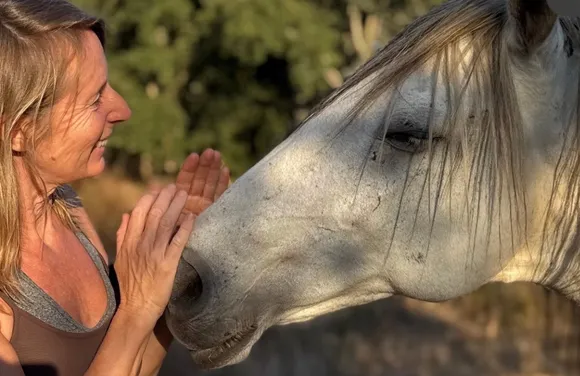
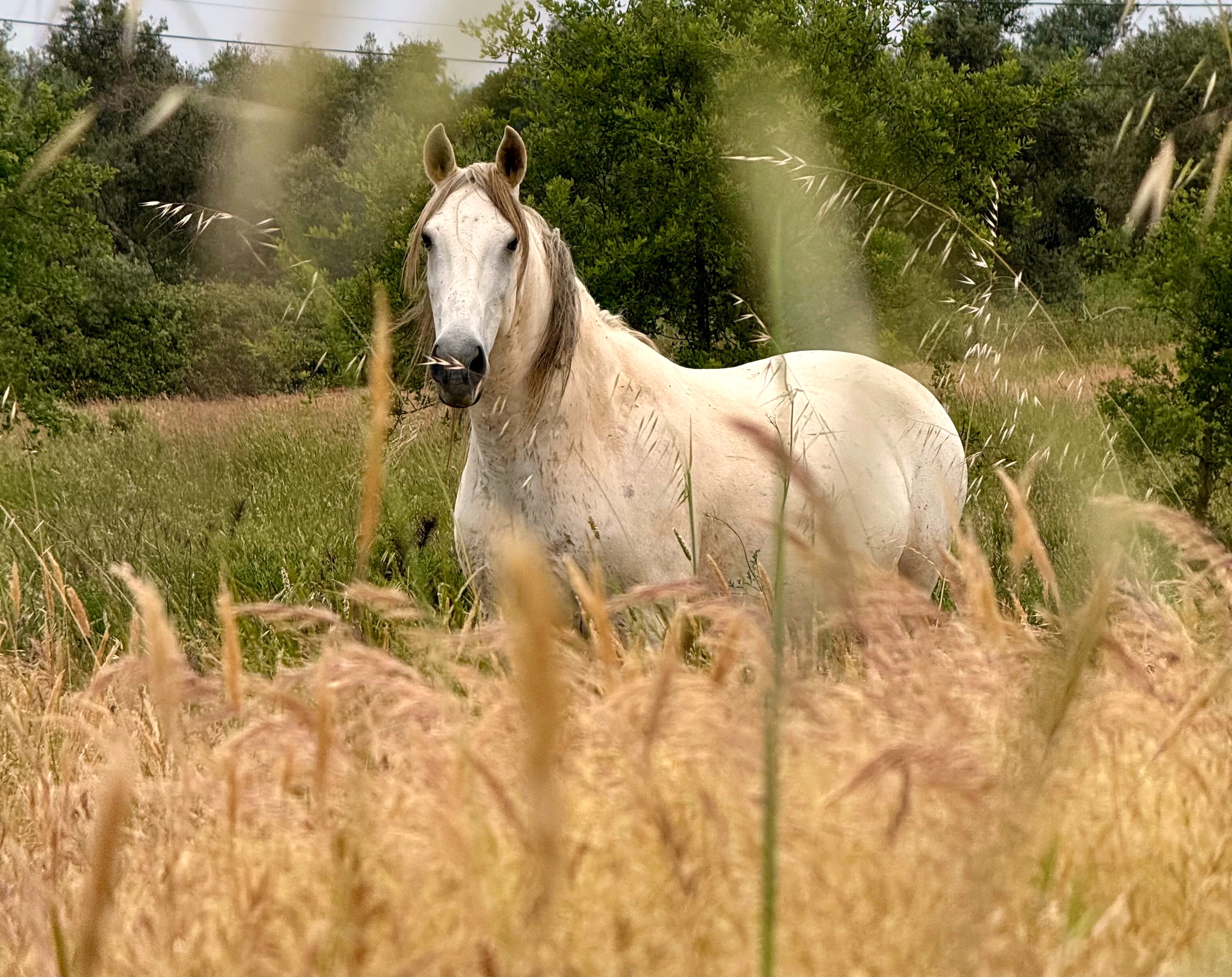
Lua came to me as a rescue. A friend found her tied to a gypsy cart, limping behind a heavily loaded wagon pulled by a brave mule, a wound open on her leg. My friend bought her on the spot to get her out of there, and I fell in love with the white mare the moment I saw her.
Covered in scars, both visible and invisible, she still had a beautiful presence. Almost unicorn-like. But she was very wary of people to the point of being impossible to catch, touch, or approach without her bolting for the hills.
I fell in love, and after some time I brought her home.
Learning the Rules of the Herd
After she'd settled in, I added her to my herd and set her loose on our 40ha land. I wasn't in a rush to do any "work" with her. Like most gypsy horses, she'd spent most of her life tethered on a rope, and what she needed first wasn't training. It was the chance to just be a horse again.
So I left her education to the herd. They taught her the rules: follow, pay attention, move as one. I watched her progress and silently thanked my lead mare, Gemma, for taking her on. For months, Gemma had to keep reminding her to stay with the group. Lua had a tendency to graze back and forth on the same spot, pacing as if she were still tethered to that rope, even though nothing was holding her anymore.
The Slow Work of Trust
I kept spending time with the herd, and gradually Lua stopped bolting the moment she saw me coming. Curiosity crept in. I couldn't approach her directly or even look at her too intently, but as I moved among the others, she'd watch me.
That summer, the flies arrived in their usual brutal numbers, and I started putting fly masks on the horses on the worst days. With Lua, I began with synchronized movement: matching her pace at a distance, finding whatever space she'd tolerate without leaving. She didn't enjoy it, but she didn't leave either. Always wary, always ready to go and that was fine by me.
Over time, she let me stand closer. Eventually I could get the fly mask on and off. Slowly, she started showing her discomfort in other ways instead of just running, and when she did, I'd back off. She was experimenting with a different option than flight. And I wanted to encourage her in that.
And then, at some point, she actually started approaching me, would get overwhelmed by her own boldness and retreat just as fast.
The Day She Followed Me Anyway
I remember one day clearly. We were back at the fly mask work, doing our usual synchronized movement, trying to find that bit of closeness that lets me get near enough. But that day she was agitated, grazing fast and hard, moving off with more energy every time I tried to close the distance. I wanted that mask on. But she wasn't having it, and after a while I realized I had a choice: keep pushing and lose everything we'd built, or stop. I usually try to end every session on some kind of positive note, however small. That day, there wasn't one to find. So I gave up on the plan entirely, turned around, and walked back to pack up my things.
As I was gathering my gear, she appeared from behind a tree. She'd actually left the herd and followed me almost 100 meters, on her own, to where I was standing. She was ready to try again.
I can't describe what that moment felt like. It still gets me, just telling it. The horse who'd refused me minutes earlier had walked away from her own herd to come find me!
Who She's Becoming
The halter was a different story for a long time. As soon as it went on, Lua would "switch off", slip into a kind of learned compliance, the gypsy-horse mode of just enduring whatever came next. Useful when the farrier needed to work on her. But there was no learning happening in that state. No her, really - just absence wearing a horse's body.
What changed things was helping her regulate her own fear, one small calming signal at a time. A tiny chew, a lowered head, a shift in weight - I literally rewarded all of it, however small. She had good days and bad days. But slowly, she began to show more interest, and eventually she started approaching me almost as if asking for interaction. Those moments were rare and unscripted, and they were the best ones.
She started self-regulating in ways I hadn't taught her directly. A small interaction, then she'd walk off, yawn for minutes releasing whatever tension had built, then circle back for more. Eventually I could touch her face, and she started playing with her mouth on my hands, her real character finally surfacing.
What still surprises me, even now, is how far she's come from the horse who once couldn't be touched. She offers interaction. She plays. Sometimes she comes up just to greet me. It's a complete reversal from the horse who arrived four years ago, terrified of every hand that came near her.
It's still ongoing. But watching her yawn through a big release is one of the most quietly moving things I get to witness, and it's the foundation everything else is built on.
♡
This story is one of several in my Horse Signals Guide, where I break down the calming and stress signals Lua, and every horse, uses to tell us how they're really doing. Get your copy here: The Horse Signals Guide


