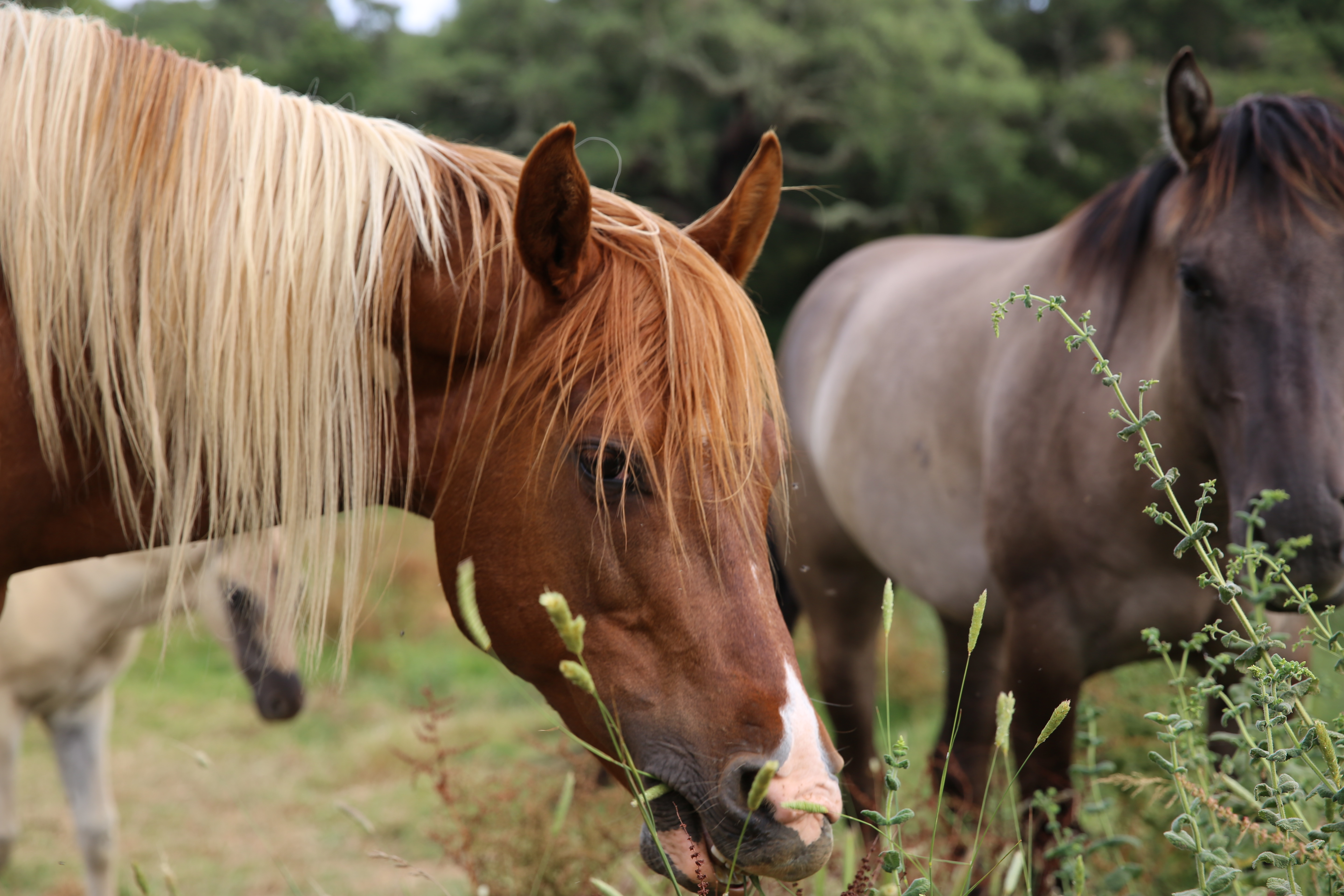
What Horses Know About Grief
“The animal shall not be measured by man..” - Henry Beston
Last week, my neighbours lost one of their horses...
They had only adopted the two mares from the horse rescue 3 weeks earlier, a more and her adult daughter, so horses were still fairly new to them. They'd checked on them the evening before, and everything was fine. Both grazing quietly in the field as the light went down.
By morning, they found the daughter deceased under the tree where the two often stood to rest..
I remember that evening. I had an inexplicable pull to go and check on my own horses, nothing I could name, just a quiet nudge. Sometimes that happens. And I went, they were fine, the water was fine. I didn't think to check the horses next door. I don't know what I would have done if I had.
We let the mother stay with her daughter's body for most of the day.
She rested beside her. She slept. Every now and then, she would nudge and paw the body gently, as if asking it to get up. As if maybe this time, it would.
We didn't rush her. We just let her have the time she needed to understand what had happened. Waiting for the moment she would give up and return to grazing or some other indication she was finished. Eventually, the rescue organisation came to collect her, to check her over, make sure she was okay. And the following morning, the company came for the body.
What I noticed, through all of it, was my own herd.
They were gathered in the corner of their field closest to the neighbours' pasture. About a 100 metres away, with trees between them. No direct line of sight. They had never been near these two mares. They didn't know them beyond an occasional whinny.
And yet there they were. Standing quietly, facing in the direction of the mares pasture. Occasionally wandering off to graze and then drifting back again. For most of the day, they simply held that corner of immensely large pasture. Still. Present. Facing toward something they couldn't see.
They stayed there the following day too, even after the mother had been collected and the body was gone. Gradually, over the next few days, they moved away. But for a while, they just... kept returning to that corner.
I've thought a lot about what I was witnessing. I could be wrong. I've been observing this herd for over 25 years and I still hold space for the possibility that I'm seeing what I want to see. But something about it felt distinct - different from their usual resting and grazing patterns, different from the way they use that space.
It brought me straight back to 5 years ago. To Dreams.
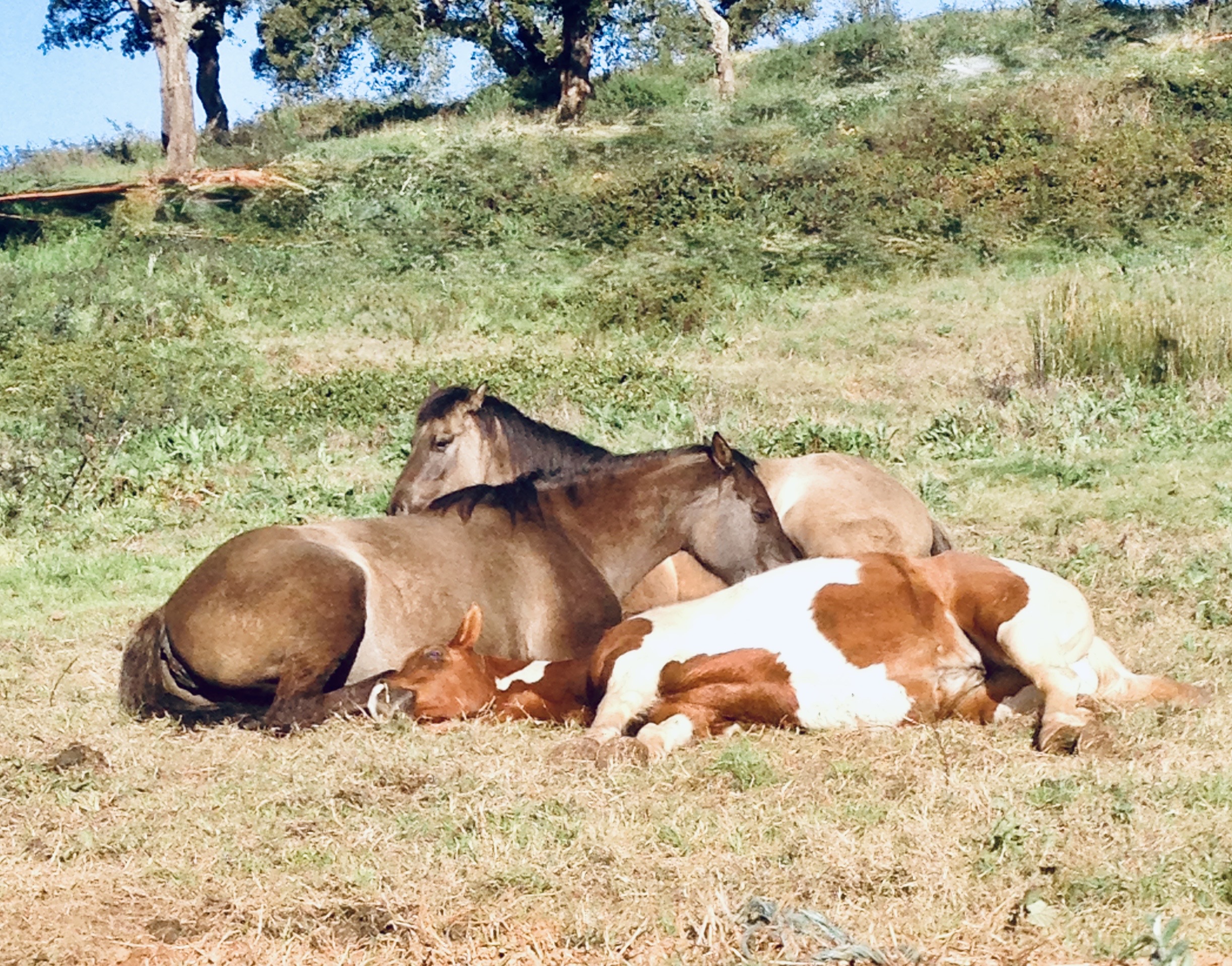
Dreams Come True was my first horse. I had her for over 20 years.
She was the one who started everything for me the oldest of the herd, and in many ways, the reason I'm doing what I do today. She was bold, expressive, and completely herself.
Her death was fast and devastating.
She had a tick fever bout that attacked her neurological system. Within hours she was having epileptic fits, and the vet and I made the decision to put her to sleep. But she didn't wait for the injection. She finally let go and died in my arms, about five minutes before the vet was ready.
Writing this now, it still touches me deeply and it feels like that was hers to do in her own way.
Because she died in the field adjacent to her herd and not with them, I covered her body with a plastic sheet and arranged for my neighbour to come the following morning with the machinery to bury her. She would have to stay there overnight.
When I arrived the next day, the horses had broken out of their own pasture.
They had found their way to her. They had grazed all around her body. I could see it clearly from how well that patch of ground had been cropped and at some point they had shifted the plastic covering slightly. They had taken their time with her. Said whatever it is horses say to each other in those moments. And then, when they were ready, they had moved on to another part of the land, where we found them late in the morning and brought them home.
I stood there for a long time that morning, looking at the grazed ground and hoof prints around her body.
What followed in the weeks and months after was something I hadn't expected.
Gemma, Dreams' closest companion, and the leader of the herd, went quiet. She spent time alone. Sometimes she called out - that particular sound a horse makes when they're looking for someone who doesn't come back. It went on for months.
Jakob, my donkey, seemed to understand something the others didn't. He positioned himself near Gemma, not crowding her, just close. Steady. He didn't try to fix anything. He just stayed. And in doing so, he seemed to find his own place in the herd in a way he hadn't quite had before. Like grief opened a space for him to step into.
And then there was Peaches, Gemma's daughter, who had known Dreams from the moment she was born into the herd. While Gemma was deep in her grieving, Peaches quietly took over the steadying role in the herd. The one who keeps an eye on things, who moves everyone to the next area, who holds the shape of the group. She did that for Gemma, without being asked, for as long as it was needed.
When Gemma came back to herself - and she did, gradually over a period of some months - Peaches stepped back. And then Peaches had her own quieter period. A few weeks of something softer, more withdrawn. As if she had been holding herself together for the herd and now finally had the space to feel it.
They took turns.
I've never forgotten that. They took turns holding the structure while the other one grieved.
I don't know exactly what horses experience when another horse dies. I'm not sure anyone does - not fully. What I know is what I observe. And what I observe, across 20 years and two different herds and two different losses, is that horses respond to death in ways that are recognisable, consistent, and unmistakably deliberate.
If they have the choice and availability to do so, they seek out the body. They stay. They face toward loss even when they cannot see it.
They reorganise around grief, covering for the ones who can't carry their weight for a while, stepping back when the time comes.
And somehow, across a hundred metres and a line of trees, they knew something last week that I only found out the next morning.
I don't think I'm imagining it.
I think we just haven't been paying close enough attention.
♡
If this story resonates with you. Or if you’ve ever questioned the old ways, or felt that quiet discomfort in your gut, you’re not alone. There is another way. One that begins with listening. With slowing down. With consent.
And that’s where the real connection begins.


