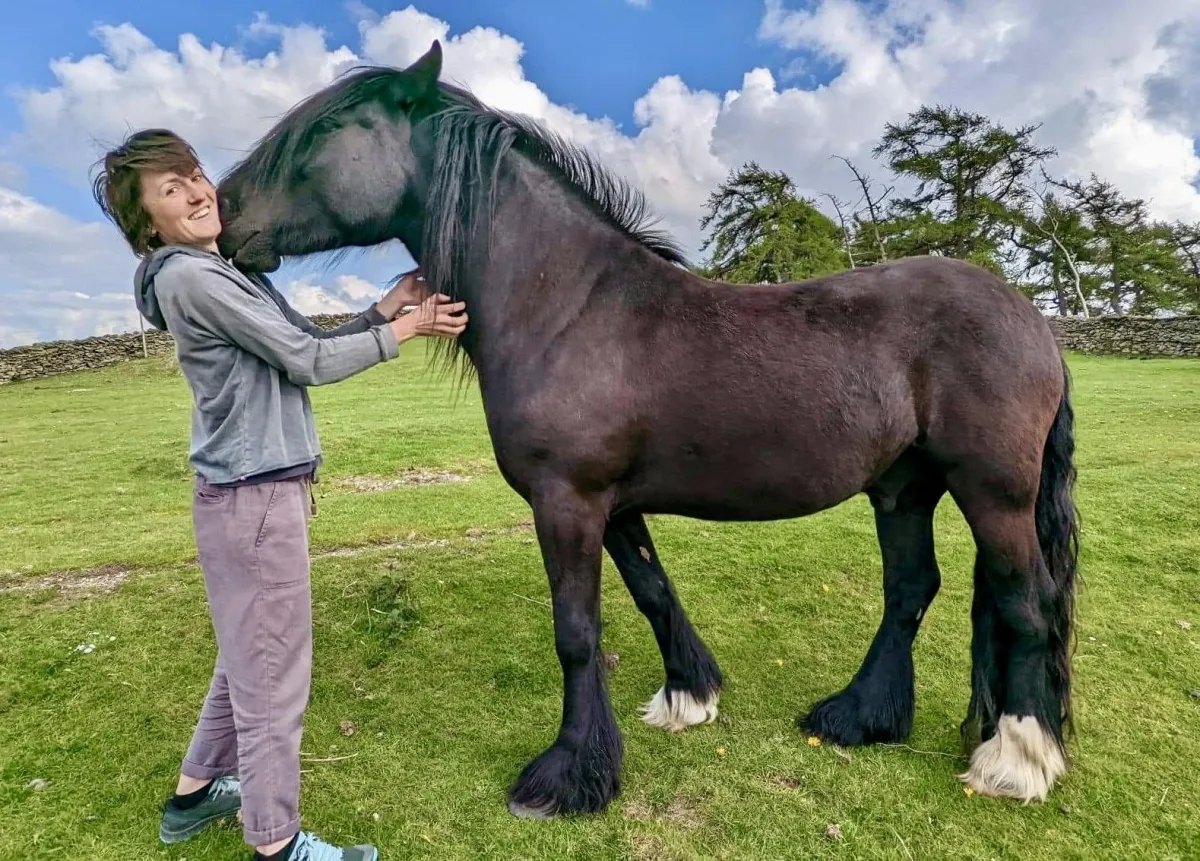
Part 1: Rachel & Atlas: Learning to Listen, Against All Odds
“Every time I ignored my intuition to please others, I lost a little of Atlas's trust. And my own.” - Rachel Keeley
Sometimes the hardest part of this path is not what happens between us and our horses, but what happens inside us when the outside world weighs in. My student Rachel Keeley shared her journey with her horse, Atlas. It’s a story of deep sensitivity, the pain of social pressure, and the lessons that come when we choose presence over performance. I’m honored to share her words here with you, exactly as she wrote them:
"With every change in Atlas’s living situation, our “training” would go back to the very first steps. We would begin again, right at the start. I knew that with every change, whether it was where he lived, whether he was inside or out, or a shift in his social circle, he was going to be deeply affected. And so was I. Each big change meant that we, together, had to re-learn things.
After living outside for some time and making great progress with going for walks, one step at a time, always tuned in to each other and turning back before any signs of stress appeared. Atlas was now living in for the winter. He was on someone else’s property, a stud farm, and I didn’t have the power to decide how he would live. I had to go along with their plans to chop and change his location and companions, much to my distress.
I’d always known that when I finally had a horse of my own as an adult, I wanted them to live as naturally as possible: outside, always with company, in a secure herd. But on somebody else’s land, it was never easy to keep my horse in a way that I felt was fully ethical, happy, and safe.
With the winter looming, Atlas was moved indoors. I felt grateful that he was with other horses, especially one colt he had lived with as a youngster. They seemed to remember each other. They got on well, with lots of mutual grooming and play, which helped me relax into the situation, knowing he had that vital sense of security through companionship.
The terrible Cumbrian weather kept us inside for a while, with the wind racing down the fell and through the farmyard. It was not a time to be training or building a deeper connection out in the wilds. Instead, we spent many hours sharing space indoors, bonding deeply, simply being together with no agenda.
We made it through the ferocious winter on the highest farm on the Cumbrian fells, and I was grateful that Atlas had not had to endure the severe conditions. When spring came, I was ready to restart our work, which he had enjoyed so much the previous summer.


I first took him into a bigger, empty space in the barn, where we could connect without other horses seeking my attention, but with them close enough that Atlas still felt the safety of their company. After a short while, we began taking small, steady steps outside the barn again, in the fresh spring light. I noticed signs of stress appearing quite quickly, so I kept these ventures very small.
It began with a single step outside the barn gate: a few breaths, standing together while taking in the outside world, readjusting our senses, broadening a world that had grown so small indoors. Familiar sights, sounds, and smells and yet somehow fresh. Then we would turn calmly back inside, to Atlas’s safe place.
These steps were physically tiny, but emotionally and psychologically huge. Every time we broadened our horizons, even just a few feet further than before, it felt like a huge achievement.
During this time (even in the previous summer when I was deeply focused on awareness of the nervous system and co-regulation) I was under a lot of pressure. People demanded I must do more with my horse. At five years old, they said he should be ridden, that he should be “broken in.” They dismissed the emotional work I was doing and made it seem like I was doing nothing at all. Even our regular and very successful long reining sessions in the field were never noticed as progress.
It hurt me deeply. To me, this work was meaningful, personal, and exactly the kind of relationship I had always dreamed of: starting a horse with no previous education, and working with him from the beginning through connection-based horsemanship. Training was never my true focus: mutual understanding was.
But with those pressures and judgments constantly weighing down on me, I received degrading comments every day about my lack of “progress.” The self-deprecating feelings grew so strong that, even though I thought I was listening closely to Atlas, I gave in. I started taking our ventures further. I let Atlas’s stress levels rise and continued on, just so it would look like I was doing more. I was not true to myself.
The result was a breach of Atlas’s confidence in my decision-making. After all the progress we had made through connection, his trust in me evaporated. He no longer felt safe.
A couple of situations arose where I noticed Atlas’s anxiety rising. Instead of listening to my gut feelings, I pushed on, trying to be more assertive, to prove myself. Both sessions ended badly. Atlas’s nervous system shifted into fight/flight. He wanted to bolt back to the barn where he felt safe.
The first time, I didn’t let go of the rope immediately, against my intuition. In his desperation, he kicked out. No physical damage was done, but I was emotionally devastated. Atlas had felt so unsafe, and I had failed his trust because of outside pressure to be “more assertive..."
To be continued...
This is where Rachel first felt the heartbreak of betraying her instincts, and Atlas’s trust, in pursuit of other people’s approval. It’s a moment so many horsewomen can relate to: the quiet knowing inside us, and the louder voices around us. In Part 2, Rachel shares what happened next and how she and Atlas found their way back to each other.
♡
If this story resonates with you — if you’ve ever questioned the old ways, or felt that quiet discomfort in your gut — you’re not alone. There is another way. One that begins with listening. With slowing down. With consent.
And that’s where the real connection begins.


